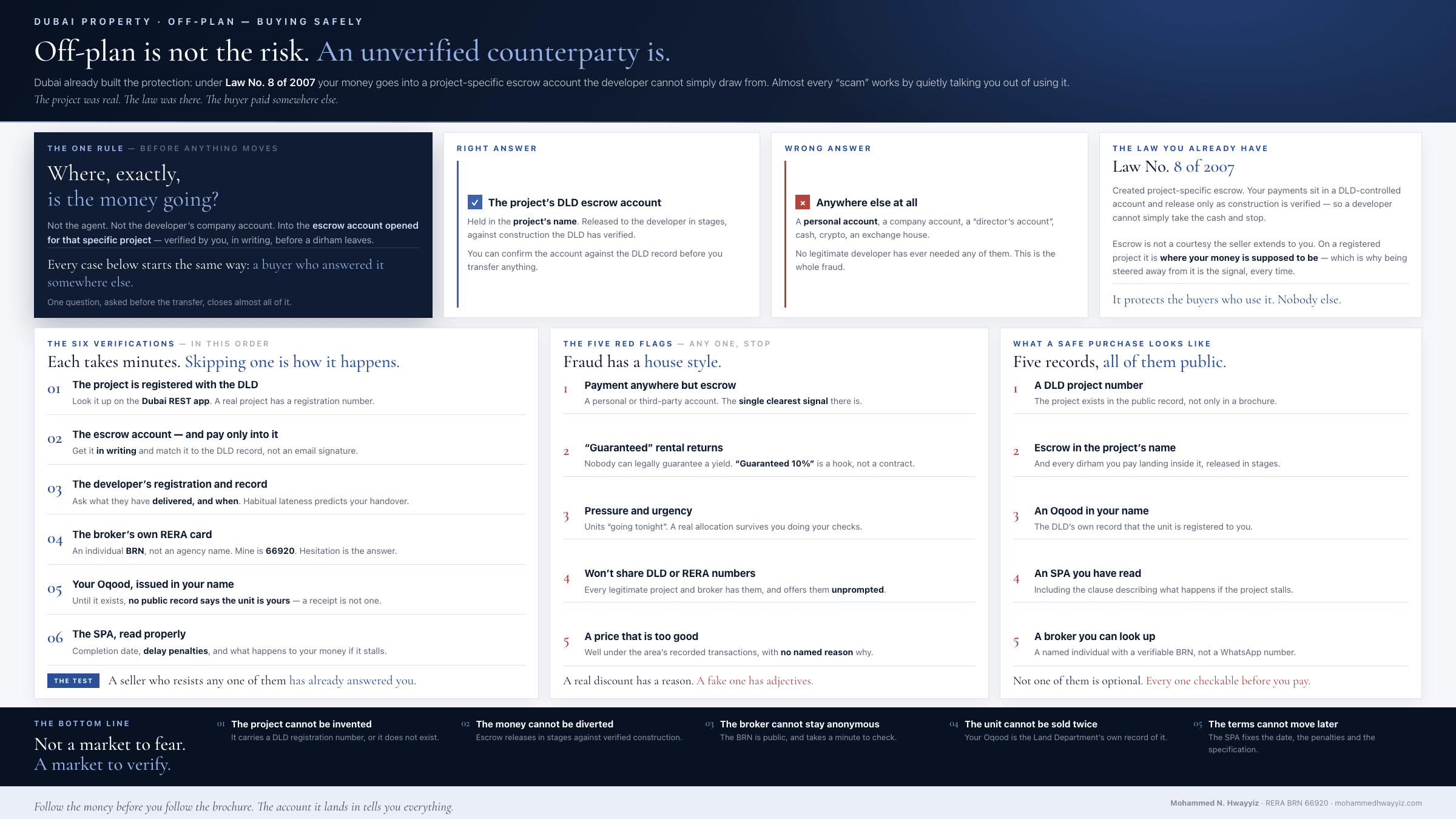
Almost every off-plan “scam” I hear about in Dubai has the same shape: the project was real, the law offered full protection, and the buyer was quietly talked out of using it.
I’m a civil engineer who became a RERA-licensed broker, and I work only on the investment side. Dubai runs one of the most regulated off-plan markets in the world — your money is meant to be protected by law from the moment you pay. Fraud happens in the gap between those protections and a buyer in a hurry. Here is exactly how to close that gap.
The one rule that stops most scams
If you remember nothing else, remember this: pay only into the project’s official DLD-approved escrow account, in the developer’s project name.
Under Dubai’s escrow law (Law No. 8 of 2007), off-plan payments go into a project-specific account controlled by the Dubai Land Department, and are released to the developer in stages, against verified construction progress — not in one lump sum. That is what stops a developer from taking your cash and vanishing.
The most common off-plan fraud is simply this: someone posing as a sales rep gives you bank details for a personal or shell-company accountinstead of the escrow account. The moment anyone asks you to pay a deposit into a personal account, an agent’s account, or any account that isn’t the project escrow — stop. That single habit prevents the large majority of losses.
The verification checklist I run before any off-plan purchase
- Confirm the project is registered with DLD. A legitimate off-plan project has a DLD project registration number and a designated escrow account. The free official Dubai REST appconnects straight to DLD’s database — check the project there yourself, don’t take a brochure’s word for it.
- Verify the escrow account — and pay only into it. Match the account named in your paperwork to the project’s DLD-registered escrow account. Every dirham goes there.
- Verify the developer’s RERA registration and track record. RERA is the regulator; a real developer is registered. But registration is the floor — their deliveredprojects (handed over, on time, holding value on resale) are the single best predictor of whether they’ll deliver yours.
- Verify the broker’s RERA card. Every licensed broker in Dubai carries a RERA registration number (a BRN) and is required to show it. Ask for it — and verify me too: my RERA BRN is 66920. A broker reluctant to give a BRN is a broker to walk away from.
- Get your Oqood. When you sign the Sale and Purchase Agreement (SPA), the developer must register it with DLD, which generates your Oqood — your formal legal record of the purchase, linked to the escrow account and eventually your title deed. No Oqood, no protection.
- Read the SPA properly. Confirm the completion date, the payment plan is tied to construction milestones (not arbitrary dates), the penalties if the developer is late, and your position if the project stalls. This is where a good conveyancer earns their fee.
The red flags that give a scam away
- Payment into a personal or third-party account instead of the project escrow. The number-one warning sign.
- “Guaranteed” rental returns.No one can legally guarantee a yield. A headline “guaranteed 10%” is a hook, not a promise you can bank.
- Pressure and urgency.“Only today,” “last unit,” “pay now to hold it.” Real deals survive due diligence; scams need you to skip it.
- Reluctance to share DLD/RERA numbers. A genuine developer and broker hand these over without hesitation.
- A price that’s too good.A “20% below market” off-plan unit with no verifiable reason is usually a story attached to an inflated anchor — or bait. A real discount can be proved against recorded DLD transactions; a fake one only ever gets asserted.
The protections already exist. A scam is almost always a buyer being persuaded, politely and in a hurry, to step around them. Slow down, verify, and pay only into escrow. The same instinct is what lets you spot a fake distress deal before it costs you anything.
The engineer’s bottom line
Off-plan Dubai is not a market you need to fear — it’s a market you need to verify. Check the project on DLD, confirm the escrow, validate the developer and the broker, register your Oqood, and read the SPA. Do those five things and the fraud vectors close one by one.
If you’re looking at an off-plan project and want a second, honest read before you pay anything — let me verify it with you. I’ll check the DLD registration, the escrow, and the developer’s track record, and tell you plainly whether it’s sound. That’s the whole job.
Once you know the market is safe to buy in, the question becomes where the value is. Start with off-plan assignments priced below the developer, or see the verified below-market deals I’m holding now.