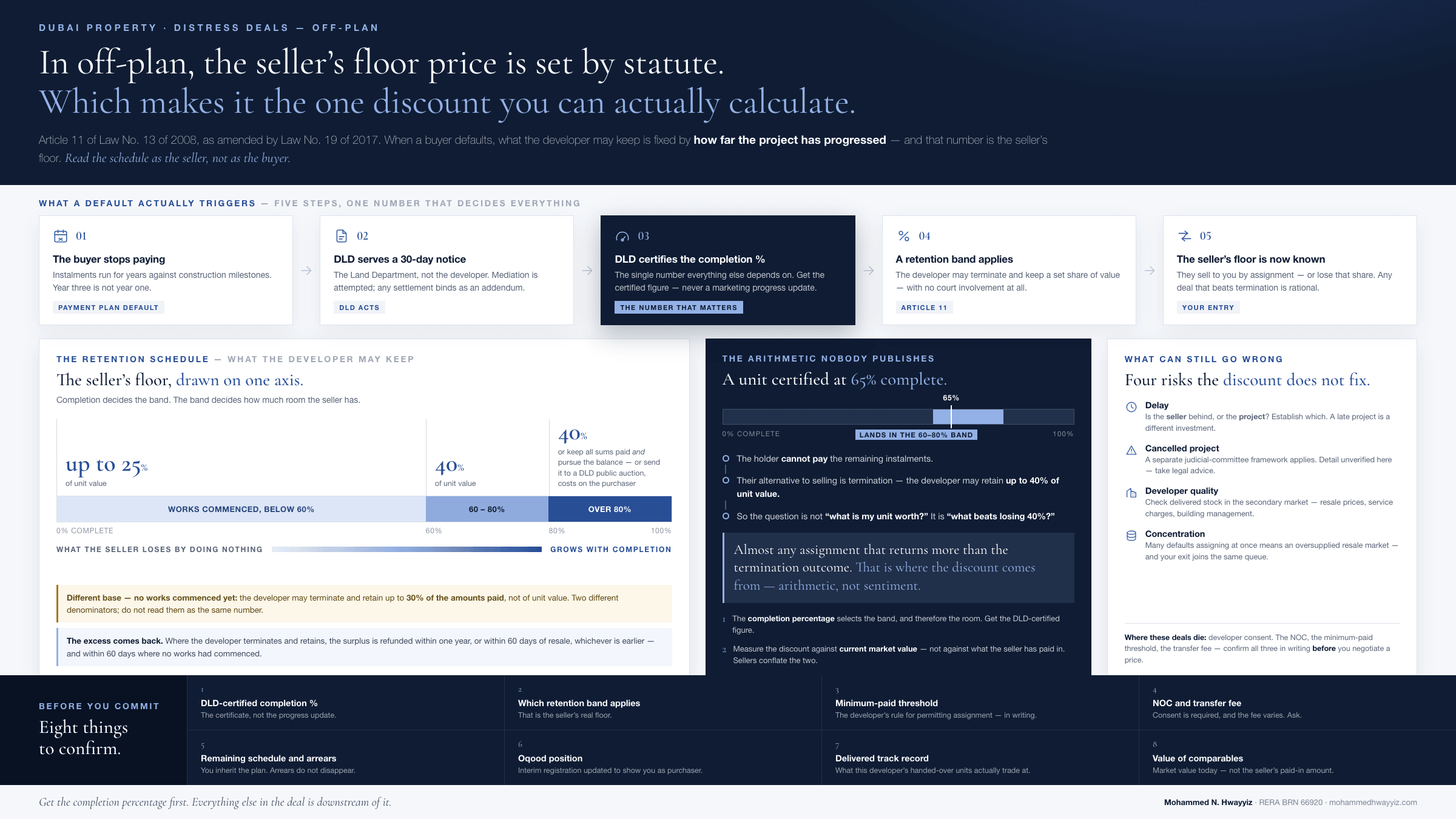
An off-plan Distress Deal in Dubai is often the most calculable opportunity in the market, because the seller’s floor price is set by law rather than by negotiation. When a buyer defaults on a payment plan, Article 11 of Law No. 13 of 2008, as amended by Law No. 19 of 2017, entitles the developer to retain a defined percentage of the unit value. That retention tells you exactly how much a defaulting seller can rationally accept.
Everyone in this market asserts a discount. This is the one case where you can derive it.
Why off-plan produces genuine distress
Off-plan in Dubai is bought on a payment plan. The buyer commits to instalments tied to construction milestones or dates, often over several years.
A lot can change in several years. Income changes, currency moves, a business needs capital, a visa situation changes. The buyer who committed comfortably in year one can be unable to pay in year three.
At that point they are not choosing between selling and holding. They are choosing between selling and losing a defined share of what they have already paid. That is a very different decision, and it produces genuine below-market pricing.
What happens when an off-plan buyer defaults
The process is set out in Article 11 and its explanatory notes.
The Dubai Land Department, not the developer, serves a 30-day notice on the purchaser requiring them to fulfil their contractual obligations. It must be in writing and dated, served personally, by registered mail, by email, or by another DLD-prescribed method. The DLD should also attempt mediation where possible, and any settlement reached becomes a binding addendum.
If the notice expires without compliance, the DLD issues an official document confirming the developer’s compliance and the unit’s completion percentage. The developer may then act without court involvement.
Note who does what. The DLD serves the notice and certifies the completion percentage. That certification is the number everything else depends on.
The retention schedule: the seller’s floor price
What the developer may retain depends on how far the project has progressed:
| Completion status | What the developer may do |
|---|---|
| Over 80% complete | Retain all sums paid and pursue the balance; or request DLD conduct a public auction with the purchaser liable for costs; or terminate unilaterally and retain up to 40% of unit value |
| 60% to 80% complete | Terminate and retain up to 40% of unit value |
| Below 60%, works commenced | Terminate and retain up to 25% of unit value |
| No works commenced | Terminate and retain up to 30% of amounts paid |
Where the developer terminates and retains, the excess is refunded within one year, or within 60 days of resale, whichever comes earlier. Where no works had commenced, the excess is refunded within 60 days.
Read that table as a seller, not as a buyer, and the pricing logic becomes obvious.
The arithmetic nobody publishes
Take a buyer holding an off-plan unit in a project certified at 65 per cent complete. They cannot pay the remaining instalments.
Their alternative to selling is termination, under which the developer may retain up to 40 per cent of unit value. That is the loss they are trying to avoid.
So the question a rational seller asks is not “what is my unit worth?” It is “what outcome beats losing up to 40 per cent of unit value?”
The answer is: almost any assignment that returns more than the termination outcome. A seller facing that retention can accept a substantial haircut on their paid-in equity and still be materially better off than letting the developer terminate.
That is the mathematical origin of the real discount in off-plan distress. It is not sentiment, and it is not the seller being unsophisticated. It is a rational response to a statutory downside.
Two things follow for you as a buyer:
First, the completion percentage is the most important number in the deal, because it determines which retention band applies and therefore how much room the seller has. Get the DLD-certified figure, not the developer’s marketing progress update.
Second, the discount should be measured against the unit’s current market value, not against what the seller has paid in. Those are different numbers and sellers frequently conflate them.
How an off-plan assignment actually works
Buying a defaulting buyer’s position means taking an assignment, sometimes called a novation or simply a resale before handover. The mechanics:
Developer consent is required. This is where most off-plan distress deals die. The developer must approve the transfer and issue an NOC. Developers commonly require that a minimum percentage of the purchase price has been paid before they will permit an assignment, and that requirement varies by developer and by project. Confirm it in writing before you negotiate a price.
Developer transfer fee. Charged by the developer for processing the assignment. Varies, so ask.
Oqood registration. Off-plan sales in Dubai are registered through the Oqood system, and the interim registration must be updated to reflect you as the new purchaser.
Outstanding instalments. You take on the remaining payment plan. Confirm the schedule and the amounts, and check whether any instalments are already in arrears, because those arrears do not disappear.
Escrow. Developer funds for off-plan projects in Dubai are held in escrow accounts under the applicable legislation. That protection applies to the project, not to your assignment agreement with the seller. Run the same DLD and escrow verification you would on a direct purchase before any money moves.
The risks specific to off-plan distress
Delay. The reason your seller is distressed may be personal, or it may be that the project itself is behind. Establish which. A project running late is a different investment from the one advertised.
Cancelled projects. Where a project is cancelled, a separate framework applies, handled through a special judicial committee established for the liquidation of cancelled real estate projects in Dubai.
I have seen the governing decree cited on commercial legal sites but did not read the primary text myself, so treat the detail as unverified and take legal advice if you encounter a cancelled project.
Developer quality.The discount does not fix a weak developer. Check the developer’s delivered projects in the secondary market, look at what the handed-over units actually trade at, and look at the service charges and building management on their completed stock. A cheap entry into a poorly delivered project is not a bargain.
Concentration. If a project has many defaulting buyers assigning at once, you are buying into an oversupplied resale market, and your own exit will face the same competition.
Why this suits the villa cycle particularly
Capital appreciation on Dubai villa projects happens during construction, and most investors in that segment are targeting return on equity rather than waiting for handover. Standard villas can typically be resold before handover into a deep pool of end users who can obtain mortgages without difficulty.
An off-plan distress assignment lets you enter that cycle partway through, at a discount, with less time to handover than the original buyer had. If the project and developer are sound, that is a strong structural position.
The exception is the ultra-prime segment. Above roughly AED 20 million, buyers are not looking for a paper discount at all. They want a finished community, and the money is typically made three to four years after handover. Distress assignments matter far less in that part of the market.
Off-plan villa projects are where this arithmetic does most of its work, and the developer-direct villa projects I track are the benchmark an assignment has to beat. If income rather than appreciation is the objective, a commercial distress deal behaves differently again — there the tenancy stack matters more than the discount.
The checklist before you commit
- DLD-certified completion percentage.
- Which retention band applies, and therefore the seller’s real floor.
- Developer’s minimum-payment threshold for assignment, in writing.
- Developer NOC and transfer fee.
- Full remaining payment schedule, and any existing arrears.
- Oqood position.
- The developer’s delivered track record in the secondary market.
- Current market value of comparable units, not the seller’s paid-in amount.
If you want an assignment underwritten before you commit, send me the project and the payment position.