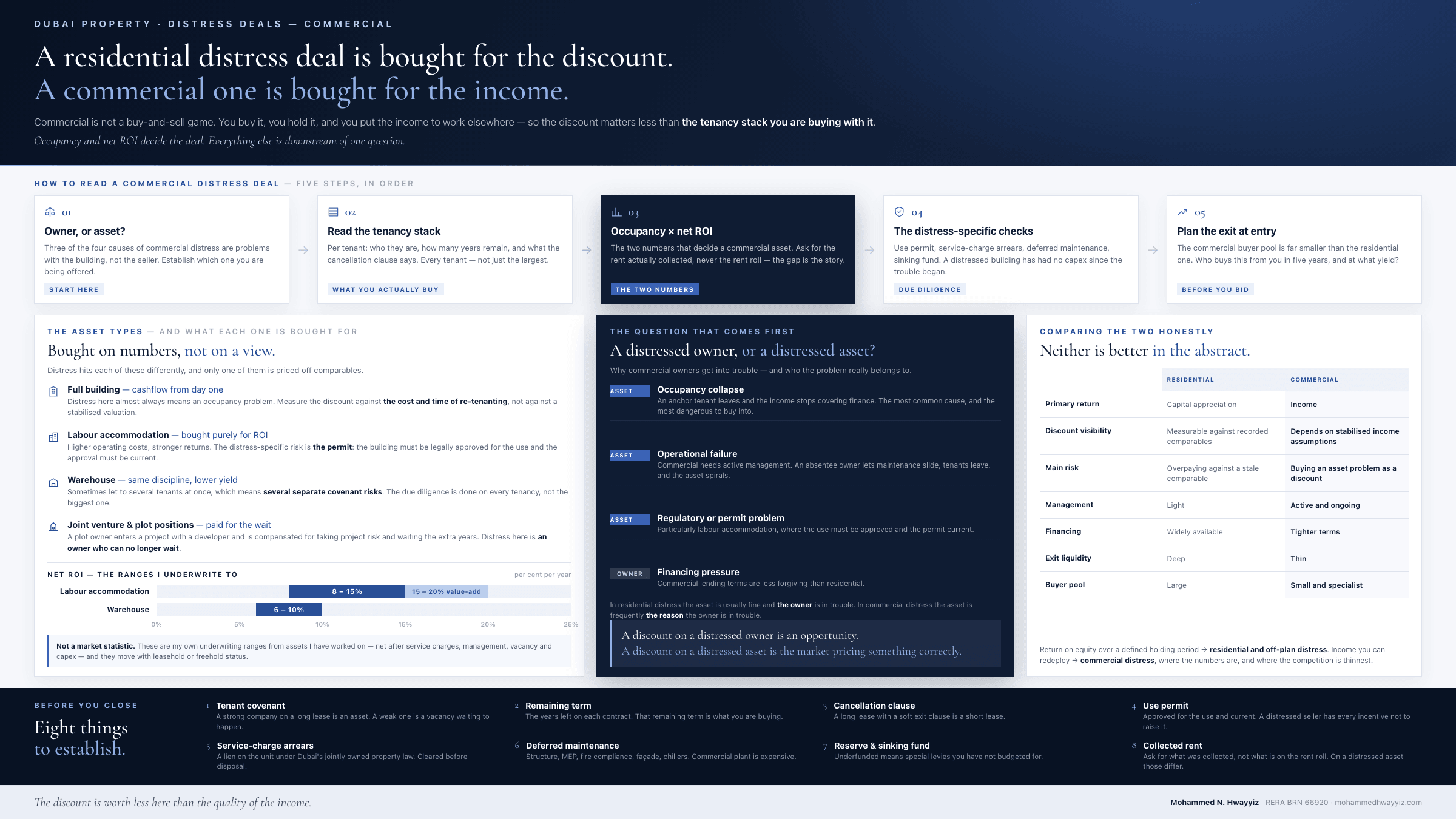
A commercial Distress Deal in Dubai is better if you want income and worse if you want a quick resale. Commercial is not a buy-and-sell game. You buy it, you hold it, and you put the income to work elsewhere. So the discount matters less than the tenancy stack you are buying with it: who the tenants are, how long their contracts run, and what the cancellation clauses say.
Almost nothing written about distressed property in Dubai covers this. Every guide on the subject covers apartments and villas. Warehouses, labour accommodation and whole buildings barely appear, despite being where the yields are.
The fundamental difference
A residential Distress Deal is usually an appreciation play. You buy below market and you realise the gain when you sell.
A commercial Distress Deal is a cashflow play. You buy an income stream, and the discount improves your yield on day one rather than your exit in year three.
That changes what you underwrite. On a residential unit, the central question is what comparable units transact at. On a commercial asset, the central questions are occupancy and net ROI. Those two numbers tell you whether it is a good deal or not.
Why commercial owners become distressed
The causes differ from residential.
Occupancy collapse. A building loses an anchor tenant and the income stops covering finance costs. This is the most common cause and the most dangerous to buy into, because you are buying the problem as well as the discount.
Operational failure. Commercial assets need active management. An absentee or inexperienced owner lets maintenance slide, tenants leave, and the asset spirals.
Financing pressure. Commercial lending terms are less forgiving than residential.
Regulatory or permit problems. Particularly relevant to labour accommodation, where a building must be legally approved for that use and the permit must be current.
Notice that three of those four are asset problems, not owner problems. That is the critical distinction. In residential distress the asset is usually fine and the owner is in trouble. In commercial distress the asset is frequently the reason the owner is in trouble.
So the first question on any commercial Distress Deal is: is this a distressed owner, or a distressed asset? A discount on the first is an opportunity. A discount on the second is the market pricing something correctly.
What you are actually buying: the tenancy stack
On every commercial deal, three questions per tenant:
- Who is the tenant? A strong company on a long lease is an asset. A weak one is a vacancy waiting to happen.
- How many years is the tenancy contract signed for? Remaining term is what you are buying.
- What is the cancellation clause? A long lease with a soft exit clause is a short lease.
For a warehouse this matters more than people expect, because a single warehouse is sometimes let to multiple tenants. Before closing, the due diligence must be done on every one of them, not on the largest.
The asset types, and how distress affects each
Full building. Bought because it is cashflow from day one. The two numbers that decide it are the occupancy rate and the net ROI. A distressed full building almost always has an occupancy problem, so the discount needs to be measured against the cost and time of re-tenanting, not against a stabilised valuation.
Labour accommodation. Bought purely for ROI. It is commercial, so it carries higher operating costs, but returns can be strong. A realistic base is in the region of 8 to 15 per cent, with the potential to reach around 20 per cent where there is genuine value-add, depending on whether the asset is leasehold or freehold. Those are my own underwriting ranges from assets I have worked on, not a published market statistic. I set out what labour camp yields really look like — zone by zone — separately.
The distress-specific risk here is the permit. A building must be legally approved for labour accommodation and that approval must be current. An expired or invalid permit is the fastest way to lose money in this asset class, and a distressed seller has every incentive not to raise it.
Warehouse. Same due diligence discipline as labour accommodation. Yields usually run lower, in the region of 6 to 10 per cent. Multi-tenant warehouses require checking every tenancy.
Joint venture and plot positions. A different structure again, where a plot owner enters a project with a development company and is compensated for taking project risk and waiting the additional years. Distress here typically means a plot owner who can no longer wait.
The distress-specific due diligence
Beyond the tenancy stack:
Service charges and building management. Commercial service charges are substantial, and a distressed building frequently has arrears. As with residential, unpaid service charges are a lien on the unit under Dubai’s jointly owned property law and must be cleared before disposal.
Deferred maintenance. This is where a civil engineer’s read earns its keep. Look at structure, MEP condition and age, fire compliance, waterproofing and façade, and chiller or AHU condition. A distressed commercial building has had no capex for as long as the owner has been in trouble, and commercial plant is expensive.
Reserve and sinking fund. An underfunded reserve means special levies you have not budgeted for.
Real versus claimed income. Ask for the collected rent, not the rent roll. On a distressed asset those are frequently different numbers, and the gap is the story.
Exit liquidity. The buyer pool for commercial assets is far smaller than for residential. Plan the exit at entry: who buys this from you in five years, and at what yield.
Comparing the two honestly
| Residential distress | Commercial distress | |
|---|---|---|
| Primary return | Capital appreciation | Income |
| Discount visibility | Measurable against recorded comparables | Depends on stabilised income assumptions |
| Main risk | Overpaying against a stale comparable | Buying an asset problem as a discount |
| Management | Light | Active and ongoing |
| Financing | Widely available | Tighter terms |
| Exit liquidity | Deep | Thin |
| Buyer pool | Large | Small and specialist |
Neither is better in the abstract. If your objective is return on equity over a defined holding period, residential and off-plan distress serve you better. If your objective is income you can redeploy, commercial distress is where the numbers are, and it is far less contested.
The bottom line
Commercial distress in Dubai is genuinely under-covered, and that is an advantage if you are willing to do harder due diligence. The discount is worth less here than the quality of the income, so underwrite the tenants, the permit, the occupancy and the true net number before you look at the price.
If you are weighing a distressed commercial asset and want the net number rather than the flyer, send it to me.