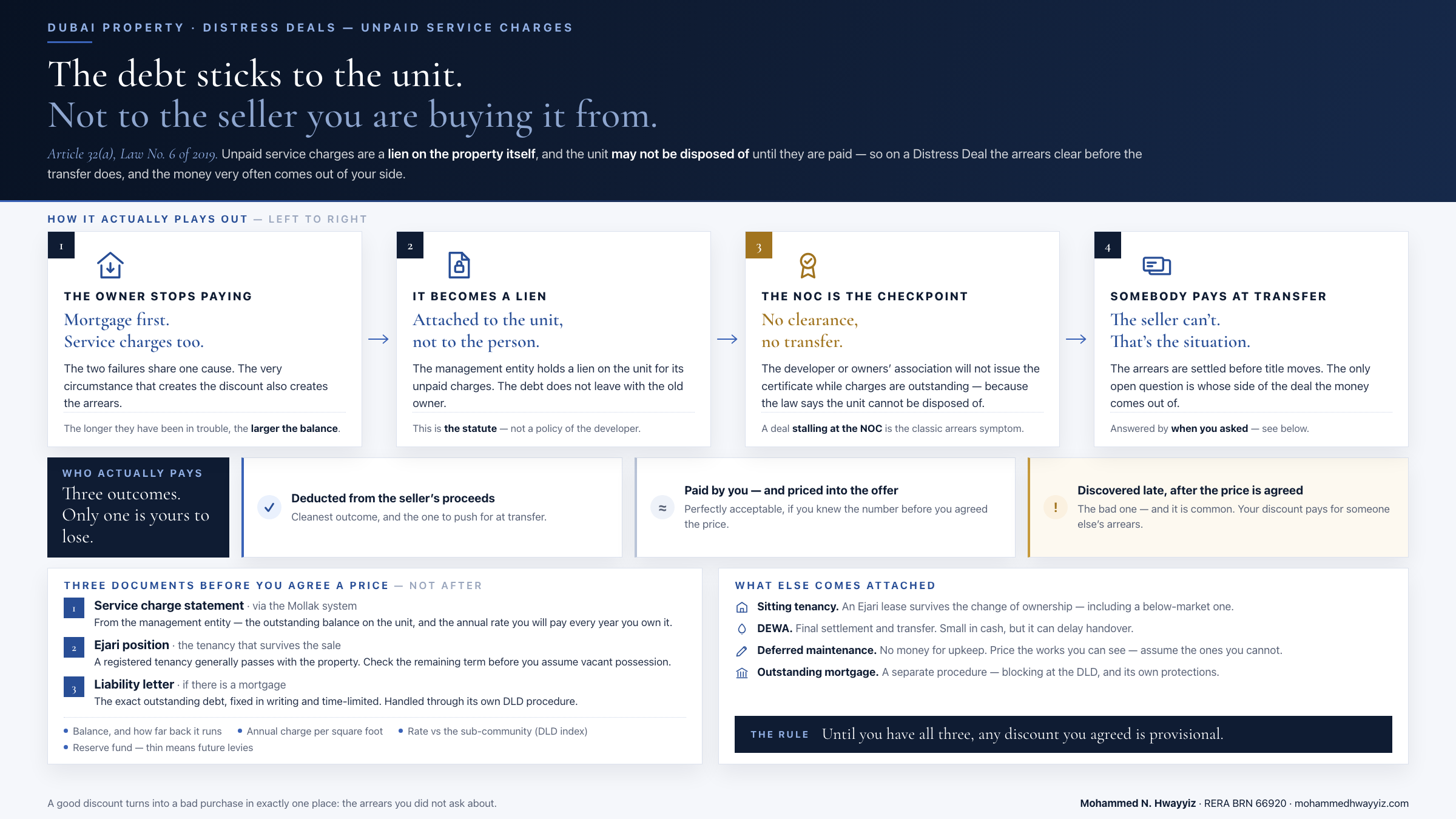
Under Article 32(a) of Law No. 6 of 2019, unpaid service charges are a lien on the unit itself, and the unit may not be disposed of until those charges are paid. The debt attaches to the property, not to the departing owner. So on a Distress Deal in Dubai, the arrears must be cleared before the transfer completes, and in practice the money very often comes out of your side of the deal.
This is the most under-reported risk in Dubai’s distressed market, and it is where a good discount quietly turns into a bad purchase.
Why this hits distressed properties specifically
An owner who has stopped paying their mortgage has usually stopped paying their service charges too. The two failures share a cause.
So the correlation is not incidental. The very circumstance that creates the discount also tends to create the arrears. A Distress Deal is more likely than an ordinary resale to carry a service charge balance, and the longer the owner has been in trouble, the larger it is.
Most articles on distressed property in Dubai mention service charges as a passing warning. Almost none explain that the law makes them a lien, which is the fact that actually determines who pays.
What the law says
Law No. 6 of 2019, concerning ownership of jointly owned real property in Dubai, sets out the position:
| Provision | What it says |
|---|---|
| Article 25(a) | The owner pays their share of the annual service charges. |
| Article 32(a) | The management entity has a lien on every unit for unpaid service charges in respect of that unit. A unit may not be disposed of unless those charges are paid to the management entity. |
| Article 32(b) | The management entity may serve a 30-day payment demand, and enforce through the Rental Disputes Settlement Centre. |
| Article 32(c) | The unit may ultimately be sold at public auction to collect unpaid charges. |
Read Article 32(a) again, because the second sentence is the operative one. The unit cannot be disposed of until the charges are paid. That is not a policy of the developer. It is the statute.
The connection nobody makes: this is why the NOC exists
When you buy in a freehold area in Dubai, the transfer requires a no-objection certificate from the developer, obtained through the Dubai REST app as an e-NOC. As of today it is changed to Certificate of clearance for service charge.
Buyers tend to treat the NOC as paperwork. It is not. It is the checkpoint where the lien is enforced. The developer or owners’ association will not issue the NOC while charges are outstanding, because Article 32(a) says the unit cannot be disposed of until they are paid.
So the sequence is: lien exists in law, NOC is the enforcement point, transfer cannot happen until it is issued. If a deal is stalling at the NOC stage, arrears are the first place to look.
Who actually pays, in practice
Legally, the charges are the owner’s obligation and the lien sits on the unit. The Dubai Land Department has publicly restated that an owner is not discharged from liability to pay service and usage charges even where a tenant fails to pay them, and that accumulated charges can lead to the unit being sold to settle them.
Practically, in a distressed sale, the seller cannot pay. That is the definition of the situation. So the arrears get resolved in one of three ways:
- Deducted from the seller’s proceeds at transfer. The cleanest outcome and the one to push for.
- Paid by the buyer and priced into the offer. Acceptable if you knew the number before you agreed the price.
- Discovered late, after the price is agreed. This is the bad one, and it is common.
The difference between outcome two and outcome three is entirely a question of when you asked.
On an auctioned property specifically, whether arrears fall to the buyer depends on the terms of that particular auction. I would not generalise here, and I would take legal advice on the individual lot.
How to check before you commit
Ask for the service charge statement for the unit before you agree a price, not after. Dubai’s service charge regime is administered through the Mollak system, and the management entity can produce a statement showing the position on the unit.
What to look at:
- The outstanding balance, and how far back it runs. A long history suggests a long-running problem.
- The annual charge per square foot, which tells you what you will pay every year you own it.
- How that rate compares with the sub-community. DLD publishes a service charge index that lets you sanity-check whether a building is expensive for its area.
- Whether the building has a healthy reserve fund. An underfunded reserve means future special levies, which is a cost that has not appeared yet.
A high service charge does not just cost you cash. It reduces net yield every year and weighs on resale value, which is why it belongs in your valuation rather than in your running costs.
What else you inherit
Service charges are the largest of the transferable liabilities, but not the only one.
Sitting tenancy. An Ejari-registered tenancy generally survives a change of ownership. If the unit is let below market, you acquire that lease, and ending it requires grounds under Dubai’s rental legislation. Check the Ejari position and the remaining term before you assume vacant possession.
DEWA. The utility account must be settled and transferred. Minor in cash terms, but it is a step that can delay handover.
Condition and deferred maintenance. A distressed owner has had no money for upkeep. Price the works you can see, and assume there are works you cannot.
Outstanding mortgage. Handled through a separate procedure with its own protections.
On a whole building the same lien logic applies at a different scale, which is part of why service charges on a commercial asset belong in the net ROI calculation rather than the closing costs.
The rule I use
Before agreeing a price on any distressed unit: get the service charge statement, get the Ejari position, and get the liability letter if there is a mortgage. Three documents. Until you have all three, you do not know what you are buying, and any discount you have agreed is provisional.
If you want a unit checked on all three before you sign anything, send it to me.