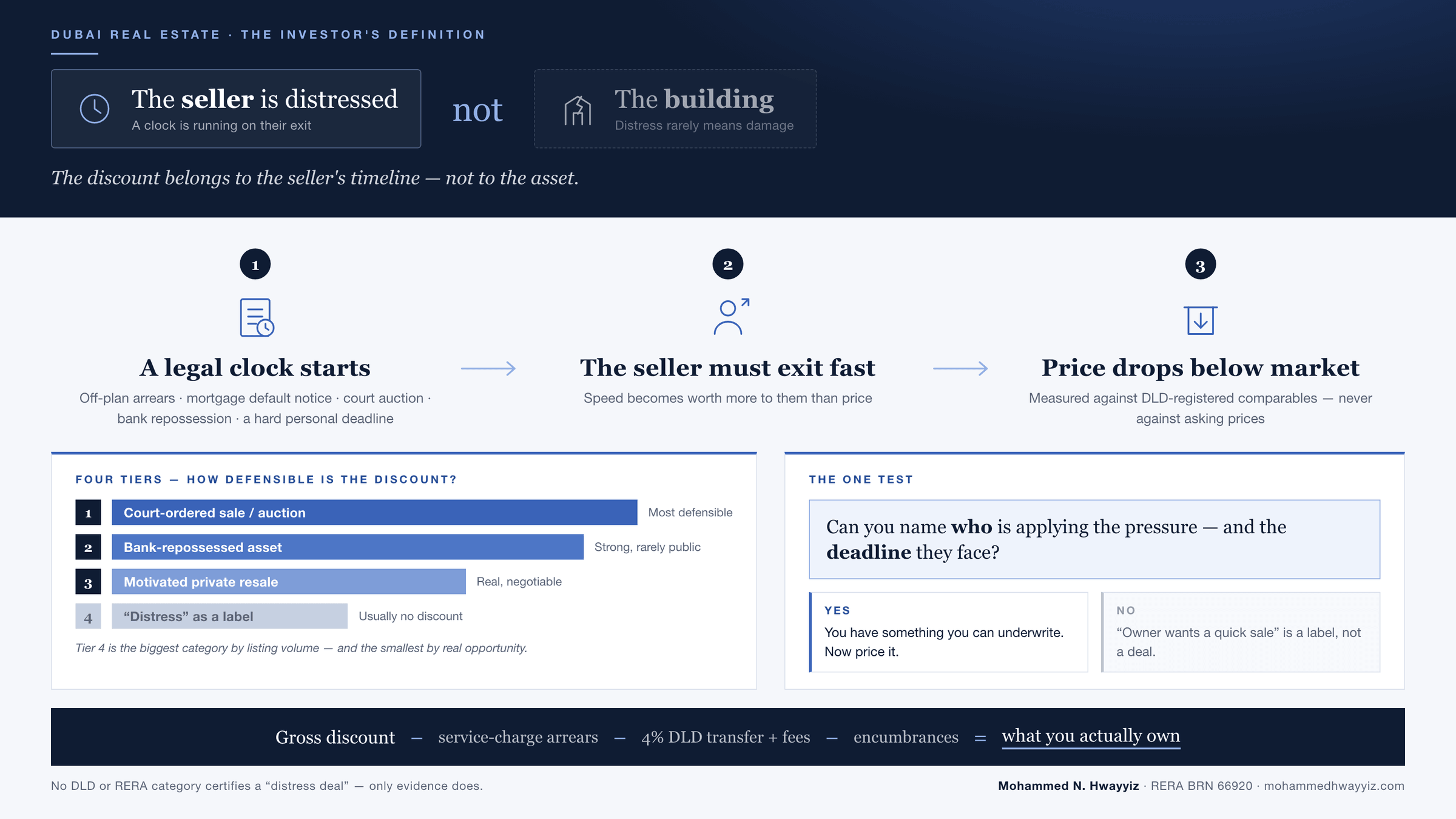
A Distress Deal in Dubai is a property sold below current market value because the seller is under pressure to exit fast, not because the property is damaged. The pressure is usually a legal deadline: a mortgage default notice, an off-plan payment plan in arrears, or a court-ordered sale. The discount belongs to the seller’s timeline, not the asset.
That distinction is the whole subject. Get it wrong and you will pay a premium for a badly built unit that someone labelled “distressed” because it had been sitting on a portal for nine months.
I am a civil engineer who became a RERA-licensed broker, and I work only on the investment side. So I don’t sell you a Distress Deal. I read it the way I used to read a structure, and I tell you what is actually holding it up. Here is the honest version.
What a Distress Deal actually means in Dubai
Distressed describes the seller, not the building
In every other context, “distressed” suggests something broken. In Dubai property it almost never does. A genuinely distressed unit is frequently in good condition, in a decent building, in a liquid community. What has failed is the owner’s position: liquidity, a visa deadline, a financing structure, a court file.
This matters commercially. A discount created by a bad layout, an obstructed view, or a weak owners’ association is not a Distress Deal. It is a correctly priced bad asset. A discount created by a seller who must sign before the end of the month, on a unit that would otherwise trade at the area’s normal rate, is the real thing.
It is not a DLD-regulated category
There is no legal definition of a “Distress Deal” in Dubai. The Dubai Land Department does not certify one, RERA does not register one, and no portal filter guarantees one. Any agent may apply the label to any listing, and many do.
So the term carries no protection whatsoever. The only thing separating a real Distress Deal from a marketing word is evidence, which is why the rest of this article is about testing it rather than trusting it.
Why a Dubai seller accepts a Distress Deal price
A seller doesn’t discount because they are generous or disorganised. They discount because a clock started. Five clocks produce almost all genuine Dubai distress stock.
| Pressure event | What starts the clock | Discount |
|---|---|---|
| Off-plan payment plan default | DLD serves a 30-day notice under Article 11 of Law 13/2008, amended by Law 19/2017 | High. The retention schedule sets a hard floor |
| Mortgage arrears | 30 days’ notice through the Notary Public under Law 14/2008, Article 25 | High. The alternative is a court auction |
| Bank repossession | Lender classifies the loan non-performing and routes it to an asset-disposal desk | Moderate to high, but rarely reaches public |
| Expat exit or relocation deadline | No statute. A visa, a job, or a school year | Variable, and easiest to fake |
| Divorce, inheritance, business cashflow | Varies. Sometimes a court settlement | Variable, often genuine but slow |
The first two are the ones worth understanding properly, because they are written into law and therefore verifiable. The last two rest entirely on what a seller tells you.
The four tiers of Distress Deal in Dubai
Not all distress is equal. Ranked by how defensible the discount is:
| Tier | What it is | Discount reality | Due diligence |
|---|---|---|---|
| 1 | Court-ordered sale or foreclosure auction | Most defensible. A judicial process sets it | Highest. You inherit the file |
| 2 | Bank-disposed (repossessed) asset | Strong, but rarely public | High |
| 3 | Genuine motivated private resale | Real, and negotiable | Moderate |
| 4 | “Distress” used as a listing label | Usually none | You are the due diligence |
Tier 4 is the largest category by listing volume and the smallest by actual opportunity. One Dubai portal currently advertises several hundred “distressed” properties. That number is a filter, not a finding.
How to test whether a Distress Deal is real
There is one question that does most of the work:
Can you name the counterparty applying the pressure, and the deadline they face?
If the answer is “the owner wants a quick sale,” you don’t have a Distress Deal. If the answer is “the developer has served notice and the buyer is at 62% completion, so termination costs them up to 40% of unit value,” you have something you can underwrite.
Then verify the price itself. A discount is meaningless without a benchmark, and the benchmark is not the asking price of similar listings. It is what comparable units actually transacted at, recorded by the DLD, adjusted for floor, view, layout and service charge per square foot. Better quality at the wrong price is still a bad deal.
What a Distress Deal can cost you after the discount
The gross discount is a headline. The net is what you own. Three things routinely eat it.
Service charge arrears. Under Article 32(a) of Law No. 6 of 2019, unpaid service charges are a lien on the unit itself, and the unit may not be disposed of until they are paid. The debt does not stay with the departing owner. Distress correlates strongly with arrears, which is exactly why this is where distress deals go wrong.
Transaction costs. The DLD transfer fee is 4% of sale value, published as a 2% / 2% split between seller and buyer, though market practice usually loads it onto the buyer. Add trustee, title deed, NOC and agency costs. Model the full cost stack before you call anything a bargain.
Encumbrances. An outstanding mortgage, a blocked title deed, a sitting Ejari tenancy. None of these are dealbreakers, but each one changes the timeline and the price you should pay.
Is a Distress Deal a good investment?
Sometimes. It depends far more on you than on the deal.
- Cash buyer with speed. The strongest position. Distress is a race, and financing slows you down. Check whether you can get a mortgage on a Distress Deal before assuming you can.
- Off-plan assignee. The most mathematically attractive route in the current market, because the seller’s floor price is set by statute rather than sentiment.
- Income investor. Residential distress gets all the attention, but commercial distress is where the yield is, and almost nobody writes about it.
And the honest caveat: a discount you cannot exit is not a discount. Before you buy, answer who buys this from you in three years, and at what price per square foot.
Where to go next
This article is the hub of a twelve-part series. The rest:
- How to find Distress Deals in Dubai
- How to buy a Distress Deal at a Dubai auction
- Buying a Distress Deal from a mortgaged seller
- Can foreigners buy a Distress Deal in Dubai?
- How to spot a fake Distress Deal
If you have been offered something described as a Distress Deal and want it underwritten before you commit, send it to me, or see the deals currently on my desk.