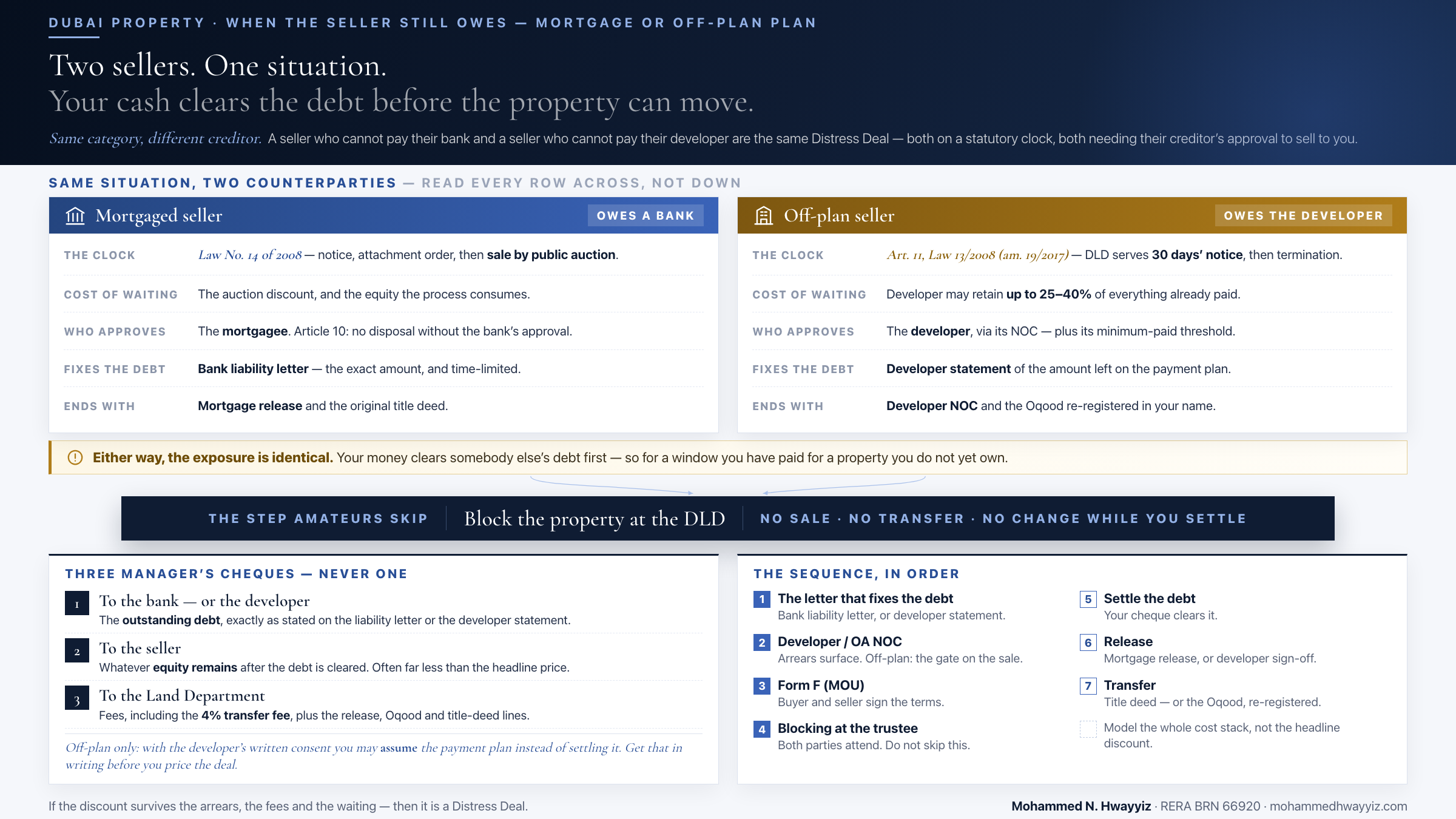
Yes, and most Distress Deals in Dubai are exactly this. A seller under financial pressure usually still owes money on the property — to a bank under a mortgage, or to a developer under an off-plan payment plan — and the sale is how they clear the debt. The transaction is legitimate and routine, but it runs through extra steps: a letter fixing the outstanding amount, blocking the property at a DLD trustee office, three separate manager’s cheques, and the creditor’s release before the property transfers.
Skipping the blocking step is the single most expensive mistake a buyer makes in this situation.
Why a seller who still owes is the most common Distress Deal
Think about who actually becomes distressed. Someone who bought with cash and hit a liquidity problem can usually wait. Someone carrying a payment they can no longer make is on a clock — and Dubai has written a clock for each version of that problem.
A mortgaged owner is on the clock in Law No. 14 of 2008, which sets out an enforcement path that ends with a court-ordered auction. An off-plan buyer who stops paying instalments is on the clock in Article 11 of Law No. 13 of 2008, as amended by Law No. 19 of 2017, which ends with the developer terminating the contract and keeping a slice of everything already paid in.
A rational owner in either position sells before the process starts. They keep control of the price, they avoid the forced-sale discount, and they walk away with whatever equity remains rather than whatever the process leaves them.
That is why this channel carries genuine motivation and, frequently, the best combination of discount and control available to a private buyer.
Same situation, two counterparties
Buyers tend to treat “mortgaged seller” and “off-plan seller who cannot pay” as different transactions. They are not. They are one situation — a seller who owes an institution that must approve the sale — with the counterparty swapped out. Read the whole article with this table beside you.
| Mortgaged seller | Off-plan seller | |
|---|---|---|
| Who they owe | A bank, under a registered mortgage | The developer, under an off-plan payment plan |
| The clock they are on | Law No. 14 of 2008: notice, attachment order, sale by public auction | Article 11 of Law No. 13 of 2008, as amended by Law No. 19 of 2017: the developer notifies DLD, DLD serves 30 days' notice, then termination |
| What waiting costs them | The auction discount, and whatever equity the process consumes | A slice of everything already paid in — the developer may retain up to 25 to 40 per cent depending on completion |
| Who must approve your purchase | The mortgagee | The developer |
| The document that fixes the debt | Bank liability letter, time-limited | Developer statement of the outstanding amount |
| What ends the process | Mortgage release and the original title deed | Developer NOC and re-registration of the Oqood |
Everything that follows applies to both. Where the mechanics genuinely diverge, I have said so rather than smoothing it over.
The legal position you need to understand
If the seller has a mortgage, two articles of Law No. 14 of 2008 govern this.
Article 10. A mortgagor may sell, donate, or otherwise dispose of the mortgaged property only with the approval of the mortgagee. In plain terms: the seller cannot transfer the property to you without the bank’s agreement. The bank is a party to your transaction whether you like it or not.
Article 11. Clauses that transfer the property automatically to the mortgagee, or that circumvent the legal sale procedure, are null and void. The process exists and cannot be contracted around.
If the seller is on an off-plan payment plan, the governing provision is Article 11 of Law No. 13 of 2008, regulating the interim real property register, as amended by Law No. 19 of 2017. It sets out what happens when an off-plan purchaser defaults, and it is a matter of public policy — a developer cannot contract around it either.
The developer must notify the Dubai Land Department of the purchaser’s non-performance. DLD then serves the purchaser a written, dated notice requiring performance within thirty days, and attempts an amicable settlement recorded as an addendum. If the thirty days expire without compliance, DLD issues an official document confirming the developer complied with the procedure and stating the percentage of construction completed. What the developer may do next turns on that percentage:
| Completion | What the developer may do |
|---|---|
| Over 80% complete | The developer may keep the agreement alive and claim the balance, request a sale by public auction, or terminate and retain up to 40 per cent. |
| 60% to 80% complete | The developer may terminate and retain up to 40 per cent. |
| Under 60%, work commenced | The developer may terminate and retain up to 25 per cent. |
| Work not commenced | The developer may terminate and retain up to 30 per cent of what was paid. |
Where a refund is due, the amount above the retained percentage must be returned within one year of termination, or sixty days from a resale of the unit, whichever comes first. Note the top row: above 80 per cent completion the developer can ask for a sale by public auction, which is how an off-plan default ends up in the same place as a mortgage default.
Read the article itself for the specific case rather than relying on a summary, including mine. The percentages are ceilings, not entitlements, and the base they are applied to is worth confirming for the contract in front of you.
The practical consequence, in both versions, is the same: the debt must be settled before the property moves, and the money that settles it is almost always yours.
The exposure window, stated plainly
Here is the problem at the centre of this transaction.
The seller owes the bank, or the developer. The creditor will not release the property until it is paid. The seller cannot pay it, which is why they are selling. So your money pays off somebody else’s debt, and only then does the property become transferable to you.
Between the moment your cheque clears the seller’s debt and the moment the property is registered in your name, you have paid for something you do not yet own.
That gap is where buyers get hurt. It is also entirely manageable, because the Dubai Land Department runs a specific procedure designed to close it.
Property blocking: the step amateurs skip
The DLD operates a service for registering the sale of a mortgaged property. In the department’s own description, it allows an application to register a mortgaged property in order to pay the amounts due to the bank, so that the rights between the parties are reserved, with the sale completed after a mortgage release letter is submitted.
That phrase, reserving the rights between the parties, is the whole point. Blocking places a restriction on the property so it cannot be sold, transferred or modified while you are settling the seller’s debt. It stops a pressured seller from taking your settlement money and dealing with someone else.
On an off-plan unit the protection works differently, because there is no title deed yet — your interest is recorded against the Oqood on the interim register. What reserves your position there is the developer’s NOC combined with the re-registration of the Oqood in your name at DLD, and the fact that the developer will not transfer the unit to anyone else once it has issued that NOC. Confirm the exact procedure for the specific project with the developer and DLD before you release funds, rather than assuming the mortgage process transfers across unchanged.
If a seller or an agent suggests skipping any of this because it is faster, that is the moment to walk. Speed is exactly what a distressed seller has an incentive to sell you.
The three manager’s cheques
DLD’s process for a mortgaged sale calls for three cheques:
- To the bank or developer, for the outstanding debt.
- To the seller, for their remaining balance after the debt is cleared.
- For the department fees, which include the 4 per cent transfer fee.
Splitting the payment this way is a protection, not a formality. It ensures the debt is extinguished at the same moment the rest of the money moves, rather than passing a lump sum to a seller and trusting them to settle with their lender.
The off-plan variant has one extra option. Instead of settling the remaining payment plan at transfer, you can sometimes assume it — taking over the instalments yourself, with the developer’s written consent. That changes the first cheque from the full outstanding balance to whatever the developer requires to release the unit. It is a genuine advantage of this route over a mortgage, where the debt has to be extinguished, but it only exists if the developer agrees in writing. Get that before you price the deal.
The sequence, in order
- The letter that fixes the debt. From the bank, a liability letter stating the exact outstanding amount. It is time-limited, so the transaction has to keep pace with it. Where the property is off-plan, the equivalent is a letter from the developer stating the remaining amount on the payment plan.
- Developer or owners’ association NOC. Confirms service charges are cleared. This is where arrears surface, and where a deal stalls if they are large. On an off-plan unit this is also the gate on the sale itself: developers set their own minimum percentage of the price that must be paid before they will issue an NOC for a resale, and it is a policy of theirs rather than a rule of law, so confirm the figure with that developer.
- Form F, the MOU between buyer and seller.
- Blocking at a DLD registration trustee office. Both parties attend. Documents include the liability letter, Form F, the developer NOC, a copy of the title deed, the cheques, and identification. On an off-plan unit, the Oqood record stands in for the title deed.
- Settlement of the debt with your cheque.
- Release. The bank issues a mortgage release or clearance letter and hands over the original title deed. On an off-plan unit, the developer confirms the plan is settled or formally transferred to you.
- Transfer. Parties return to the trustee office and the property is registered in your name — as a title deed, or as a re-registered Oqood where the project is still under construction.
Published fee lines on the DLD’s mortgaged-property service include a base service fee of AED 1,000, a knowledge fee of AED 10, an innovation fee of AED 10, a service fee of AED 525, a mortgage release procedure fee of AED 1,290, a registrar release fee of AED 315, and the title deed at AED 250, alongside the trustee and transfer costs. An off-plan transfer carries its own additions — the developer’s NOC fee and the Oqood registration — which vary by developer. Model the whole stack rather than these lines alone.
What to check before you commit
- Does the outstanding figure make sense against the price? If the debt is close to or above the sale price, the seller has little or no equity, and the deal depends entirely on the bank or developer agreeing to the terms.
- Are there service charge arrears, and how large? These must clear before the NOC is issued.
- On an off-plan unit, has the seller paid enough to qualify for a resale NOC at all? If they are below the developer’s threshold, there is no deal to structure yet, however motivated they are.
- On an off-plan unit, what is the completion percentage, and has the developer already notified DLD of a default? That tells you how much time the seller actually has, and it is the single most useful thing you can ask.
- Is there a sitting tenant? Check the Ejari position before you assume possession.
- Is the title deed already blocked by someone else, or the Oqood already assigned? Verify the property’s status through DLD’s own channels rather than taking the seller’s word.
- Is the discount real once the process costs are counted?
Why this is usually the better route than an auction
Compare the two honestly:
| Seller who still owes | Court auction | |
|---|---|---|
| Discount | Negotiated, real | Structural, often larger |
| Inspection | Normally available | Usually limited or none |
| Financing | Possible with planning | Very difficult, short settlement window |
| Timeline control | Reasonable | Fixed and unforgiving |
| Liabilities | Surface during the NOC process | May arrive with the lot |
| Certainty | Good | Lot can be postponed |
For most private investors, buying from a seller who still owes gives up some discount in exchange for a great deal more control. That is usually the right trade.
If you have a Distress Deal in front of you — a mortgage or an off-plan plan the seller can no longer carry — and want the structure checked before you sign a Form F, send it over.