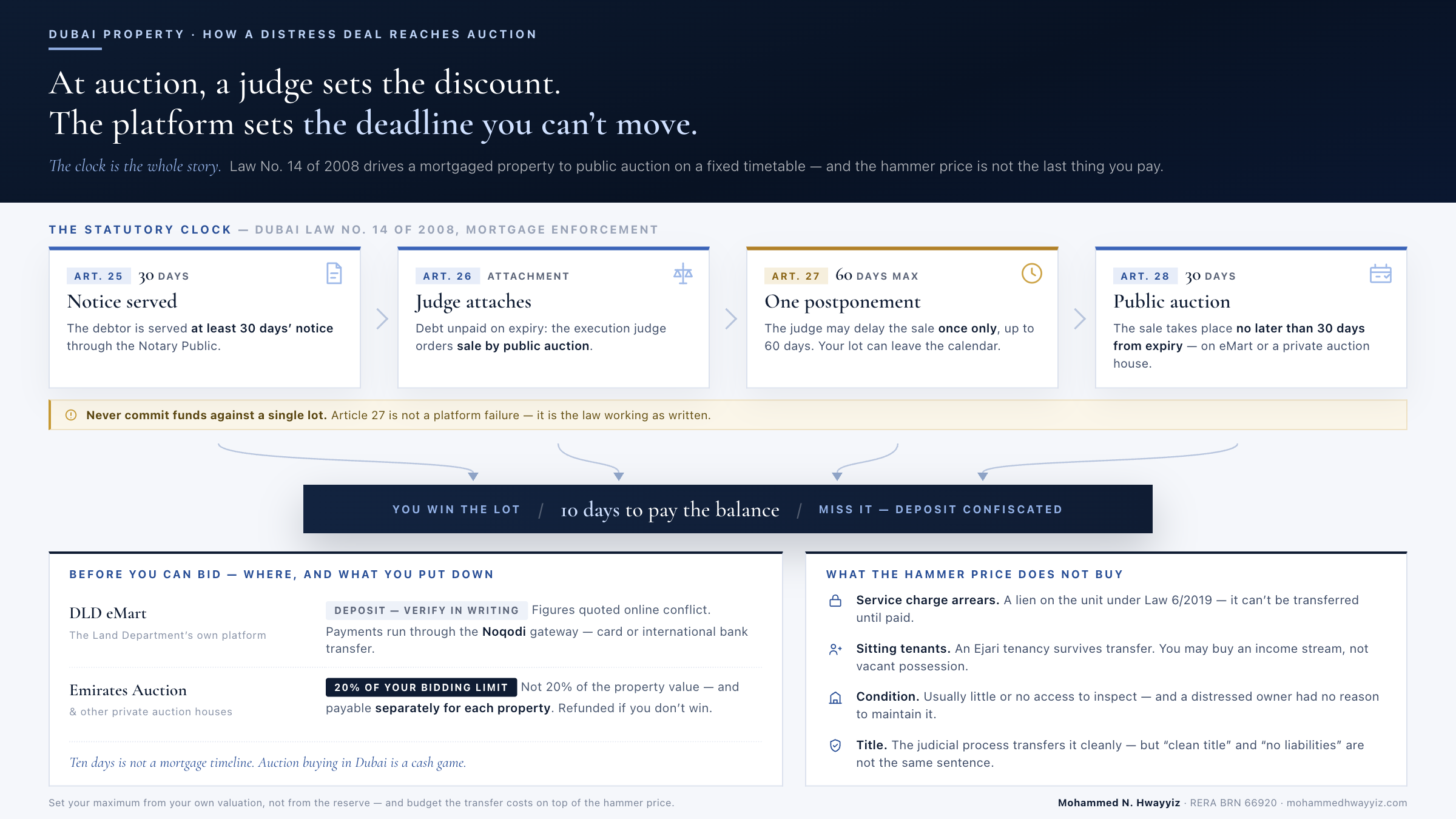
You buy a Distress Deal at a Dubai auction by registering with the platform running the sale, placing a refundable deposit, bidding, and then settling the balance inside a short fixed window. The discount is the most defensible in the market because a judicial process sets it rather than a negotiation. The trade-off is that you take the property with its history attached, and you usually need cash.
This is the tier where the legal mechanics matter most, so this article covers them from the primary law rather than from what circulates online.
How a property gets to auction in the first place
Dubai’s mortgage enforcement process is set out in Law No. 14 of 2008. The sequence runs like this:
| Article | Step | What the statute says |
|---|---|---|
| Article 25 | Notice served | The debtor is served at least 30 days' notice through the Notary Public. |
| Article 26 | Attachment order | If the debt is unpaid on expiry, the execution judge issues an attachment order against the mortgaged property, on the creditor's request, so it can be sold by public auction. |
| Article 27 | One postponement | The judge may postpone that auction one time only, for a period not exceeding 60 days, where the debtor can repay within the window or would suffer gross damage. |
| Article 28 | Public auction | The sale by public auction takes place no later than 30 days from expiry. |
Article 27 is the one that catches buyers out. A lot you have researched, valued and budgeted for can disappear from the calendar because the debtor obtained a postponement. That is not a platform failure. It is the law working as written, and it is why you should never commit funds against a single auction lot.
There is also a rule set governing what happens if a first auction fails, including reductions to the assessed value. I have seen figures for this quoted on commercial legal sites but could not confirm them against the statute text, so I am not going to state them as fact. Ask the platform or your lawyer for the current position on the specific lot.
Where Dubai property auctions actually happen
Two routes matter.
DLD eMart. The Dubai Land Department’s own auction platform. Financial transactions run through the Noqodi e-payment gateway, and buyers can pay by card or by international bank transfer to partnered banks. DLD retains the right to offer a property through the electronic auction or a public auction depending on the owner declarations, court decisions, or other legal authorisation behind the listing.
Private auction houses. Emirates Auction is the largest, and others operate in this space. Their terms are their own, and they differ from eMart’s in ways that matter to how you fund a bid.
The deposit rule most articles get wrong
This is worth reading carefully, because I found three different figures circulating online and they are not describing the same thing.
Emirates Auction’s own published terms state that the security deposit is 20 per cent of your bidding limit, not 20 per cent of the property’s value. That is an account-level concept. It changes how you fund a campaign: if you intend to bid on several lots, the deposit is payable for each property separately.
The deposit is refunded if you do not win. If you are the highest bidder, you cannot withdraw.
Deposit percentages quoted for eMart specifically vary between sources and I could not confirm a figure on a DLD page, so verify that directly with the platform before you budget. Do not rely on a number you read in a blog, including the ranges that appear across most articles on this topic.
The settlement window is the real constraint
Emirates Auction’s published terms give the winning bidder 10 days from the date the bid is approved to pay the balance. Miss it and the deposit is confiscated and the property returns to auction.
Ten days is not a mortgage timeline. It is barely a valuation timeline.
This single fact is why auction buying in Dubai is effectively a cash game. If you intend to finance, you need approval in principle, a valuation the lender will accept, and a lender who understands the deadline, all arranged before you bid. Most buyers discover this after they have won. The same ten days are what decide whether an overseas buyer can bid at all — nationality never was the obstacle; moving funds in time is.
What the hammer price does not buy you
Winning the lot settles the price. It does not settle everything attached to the property.
Service charge arrears. Under Article 32(a) of Law No. 6 of 2019, unpaid service charges are a lien on the unit, and the unit may not be disposed of until they are paid. Distressed assets frequently carry arrears. Whether they fall to you on an auctioned unit depends on the specific auction terms, and this is an area where I would tell you to take legal advice on the individual lot rather than rely on a general rule.
Sitting tenants. An Ejari-registered tenancy does not evaporate at transfer. If the unit is occupied, you are buying an income stream and a legal position, not vacant possession.
Condition. You will usually have limited or no access for inspection. A distressed owner has had no incentive to maintain the asset, and in some cases has had an active incentive not to.
Title. The point of the judicial process is that title transfers cleanly. But “clean title” and “no liabilities” are not the same sentence.
Should you buy at auction at all?
Honest answer: for most private investors, no, and there is no shame in that.
The auction route suits you if:
- You are buying with cash, or with financing fully arranged in advance.
- You can absorb the possibility that a lot is postponed under Article 27 after you have done the work.
- You have done the valuation independently, from recorded transactions, rather than anchoring to the reserve.
- You can carry an unexpected liability without it breaking the deal.
It does not suit you if you need a mortgage, need vacant possession on a date, or need certainty of outcome. In those cases a pre-foreclosure private purchase from a mortgaged owner gives you most of the discount with far more control.
A practical sequence
- Identify the lot and the platform, and confirm which legal route it came from.
- Value it independently from recorded DLD transactions for comparable units.
- Read the specific auction terms for that lot, particularly on arrears and tenancy.
- Confirm the deposit basis and the settlement window in writing.
- Set your maximum from the valuation, not from the reserve, and do not move it in the room.
- Budget the transfer costs on top of the hammer price.
If you would rather have someone underwrite a lot before you place a deposit, that is what I do.