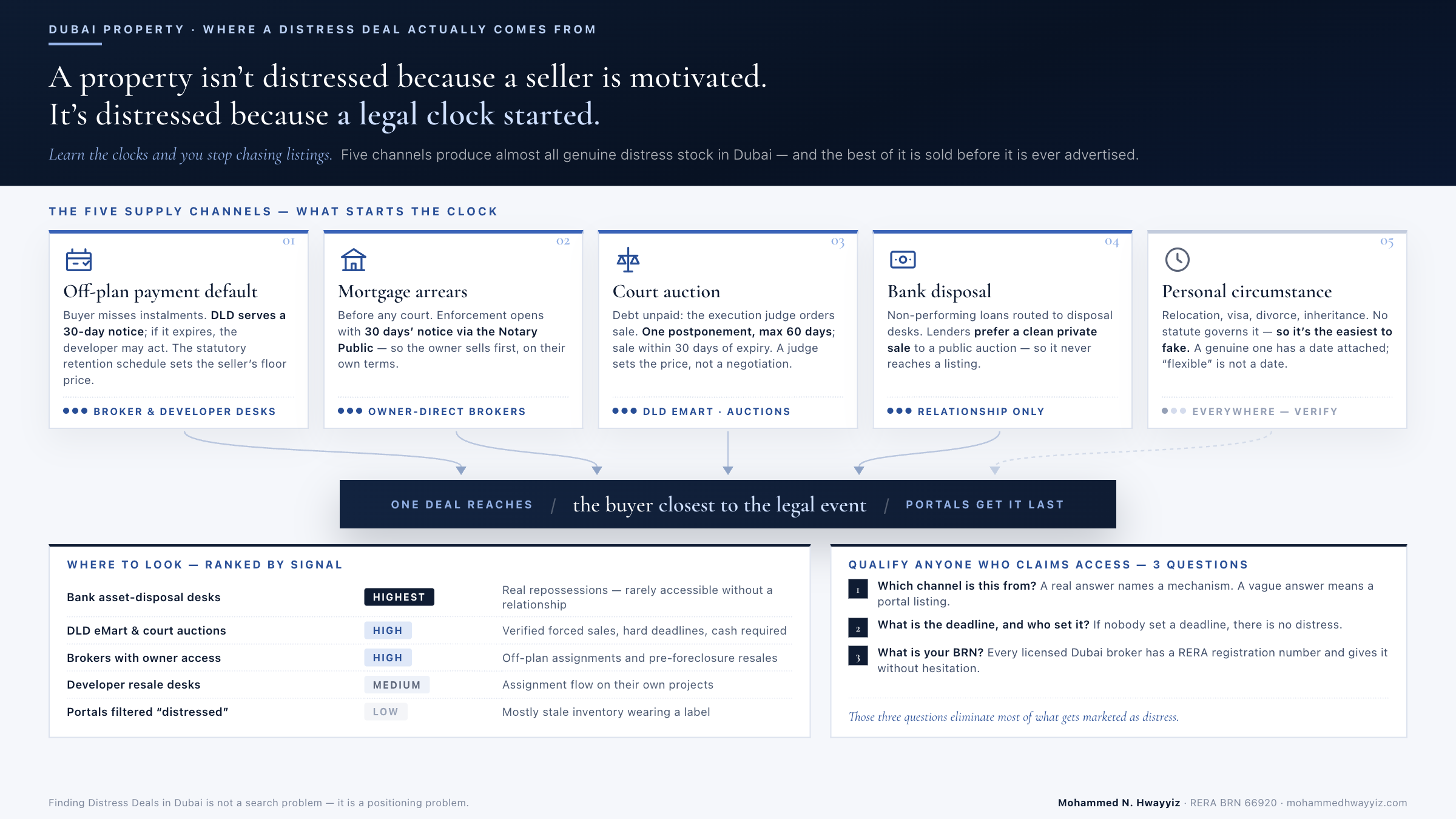
You find a Distress Deal in Dubai by tracking the legal events that force an owner to sell, not by browsing listings. A property does not become distressed because a seller is motivated. It becomes distressed because a clock started: a notary notice, a missed instalment against a retention schedule, an execution file, a bank’s non-performing classification.
Learn the clocks and you stop chasing listings.
That is the opposite of how this question is usually answered. Most guides hand you a list of websites. Websites are where distress stock arrives last, if it arrives at all.
Channel 1: Off-plan payment plan default
This is the largest source of genuine below-market pricing in Dubai and the least understood.
When an off-plan buyer stops paying, Article 11 of Law No. 13 of 2008, as amended by Law No. 19 of 2017, sets the process. The Dubai Land Department, not the developer, serves a 30-day notice requiring the buyer to meet their obligations, and the DLD attempts mediation where possible. If the notice expires without compliance, the DLD issues an official document confirming the unit’s completion percentage, and the developer may then act without going to court.
What the developer may retain depends on how far the project has progressed. That retention schedule is what sets the seller’s floor price, and it is why a defaulting buyer will accept a discount that looks irrational from the outside. The arithmetic is worked through in detail separately.
Where these deals surface:broker networks handling assignments, and developers’ own resale desks. Rarely on portals, because the seller is trying to move before the notice period runs out.
Channel 2: Mortgage arrears, before the court gets involved
Most owners in trouble do not wait for foreclosure. They sell.
Under Law No. 14 of 2008, a mortgagor may not dispose of a mortgaged property without the mortgagee’s approval (Article 10), and enforcement begins with at least 30 days’ notice served through the Notary Public (Article 25). An owner who can see that sequence starting has a strong incentive to find a buyer first, on their own terms.
These are frequently the best deals available to a private buyer, because the seller is under real pressure but the asset has not yet been through a court process. The transaction is more complex than a standard resale, since the bank must be settled and the property blocked at a DLD trustee office before transfer.
Where they surface:brokers with genuine owner relationships, and occasionally portals where the listing carries no indication of the seller’s position at all.
Channel 3: Court-supervised auction
If the notice period expires and the debt is unpaid, the execution judge may issue an attachment order for sale by public auction (Article 26 of Law 14/2008). The judge may postpone that sale one time only, for a period not exceeding 60 days (Article 27), and the sale takes place no later than 30 days from expiry (Article 28).
This is the most defensible discount available, because a judicial process sets it rather than a negotiation. It is also the channel with the highest due-diligence burden, the tightest payment deadlines, and the least room for financing.
Where they surface:DLD’s eMart platform and private auction houses. How to buy at a Dubai auction.
Channel 4: Bank-disposed assets
Not every repossession reaches an auction. Lenders classify non-performing loans and route the underlying assets to disposal, often selling through licensed agents before any public listing exists.
Be careful with the claims made about this channel. Figures circulate online about what share of Dubai mortgage borrowers default, and I have not found a source for any of them, so I will not repeat one. What is verifiable is the mechanism: banks do dispose of repossessed stock, and they generally prefer a clean private sale to a public auction.
Where they surface: bank asset-disposal desks and the small number of brokers they work with. Not publicly.
Channel 5: Personal circumstance
Relocation, visa expiry, divorce, inheritance, a business needing liquidity. No statute governs these, which is both why they are common and why they are the easiest for a listing to fake.
A genuine one has a date attached. “The owner is flexible” is not a date. “The family leaves on the 30th and the school year starts elsewhere” is.
Where they surface: everywhere, including portals. Which is why this channel needs the most verification.
All five channels run on the income side of the market too, but where commercial distress comes from is a different question — there the building itself is usually the reason, not the owner.
Why the genuinely good stock is not on the portals
Two structural reasons, and both are worth understanding.
First, urgency and publicity work against each other. A seller who needs to complete inside a few weeks does not want a public listing that advertises weakness to every buyer who sees it. They want one buyer who can move.
Second, the official auction route has a document barrier that most people never see. To list a property for auction through DLD’s eMart, a seller must produce a DLD valuation certificate for auction purposes, valid six months, along with the original title deed, site plans, Emirates ID for all owners, a declaration of sale, a property specifications statement, and a no-objection certificate from the competent authority, which means the developer or the owners’ association, plus the bank if the property is mortgaged.
That is a substantial stack, and it explains something important: genuine auction supply is thin, and it is thin for structural reasons. When a portal advertises hundreds of “distressed” properties, that number is not measuring the same thing.
Where to look, ranked by signal
| Source | Signal | What you actually get |
|---|---|---|
| Bank asset-disposal desks | Highest | Real repossessions, rarely accessible without a relationship |
| DLD eMart and court auction announcements | High | Verified forced sales, hard deadlines, cash required |
| Broker networks with genuine owner access | High | Off-plan assignments and pre-foreclosure resales |
| Developer resale desks | Medium | Assignment flow on their own projects |
| Portal listings filtered for “distressed” | Low | Mostly stale inventory wearing a label |
The pattern is consistent: access is a function of being close to the legal event, not close to a search filter.
How to qualify a broker who claims access
If someone tells you they have Distress Deals, three questions settle it quickly:
- Which channel does this come from? A real answer names a mechanism: an assignment ahead of a DLD notice, a pre-foreclosure resale, a bank disposal. A vague answer means a portal listing.
- What is the deadline and who set it? If nobody set a deadline, there is no distress.
- What is your BRN? Every legitimately licensed Dubai broker has a RERA broker registration number and can give it to you without hesitation.
Those three questions eliminate most of what gets marketed as distress.
The honest summary
Finding Distress Deals in Dubai is not a search problem. It is a positioning problem.
The stock exists because of specific legal events, those events are known to a small number of people before they become public, and by the time a unit is listed as distressed it has usually already been offered to someone closer to the source.
If you want to be on that list rather than searching for it, tell me what you are looking for, or see what is currently on my desk.