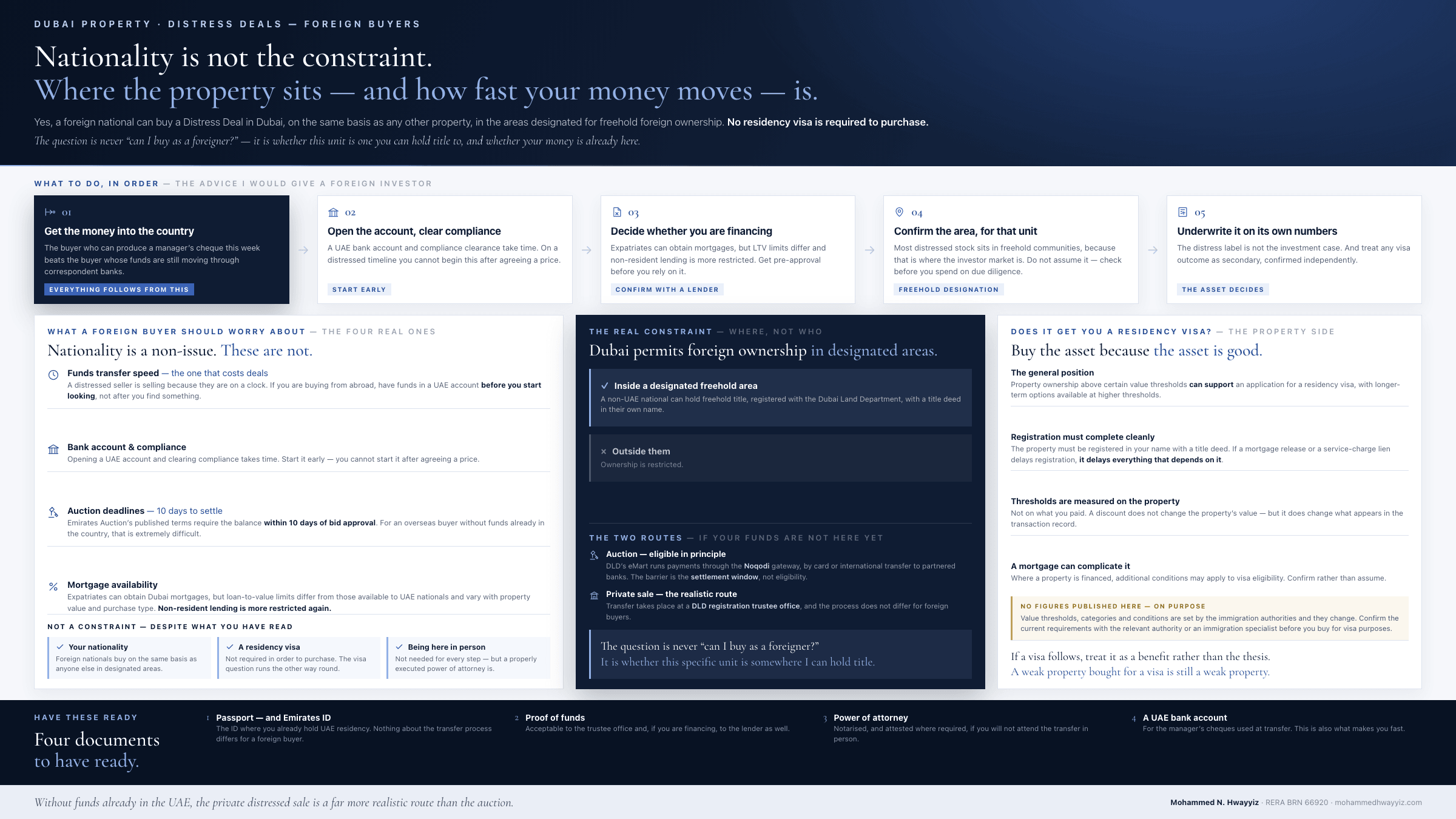
Yes. Foreign nationals can buy a Distress Deal in Dubai on the same basis as any other property, in the areas designated for freehold foreign ownership. Nationality is not the constraint and residency is not required to purchase. What actually constrains a foreign buyer is location eligibility, the speed of moving funds internationally, and, at auction, the settlement deadline.
This is the most-asked question on this topic and it is usually answered in one line and left there. The one-line answer is correct but not useful, so here is what actually matters.
The real constraint is where, not who
Dubai permits foreign ownership in designated areas. In those areas a non-UAE national can hold freehold title, registered with the Dubai Land Department, with a title deed in their own name. Outside them, ownership is restricted.
So the question is never “can I buy as a foreigner?” It is “is this specific unit in an area where I can hold title?”
Practically, most of the stock that gets marketed as distressed sits in the freehold communities, because that is where the deep investor market is. But do not assume it. Confirm the designation for the specific property before you spend money on due diligence.
You do not need a UAE residency visa to buy, and you do not need to be physically present for every step, though a properly executed power of attorney is required if you are not.
What a foreign buyer should be more worried about
Nationality is a non-issue. These four are the real ones.
Funds transfer speed.This is the one that costs foreign buyers deals. A distressed seller is selling because they are on a clock, and the buyer who can produce a manager’s cheque this week beats the buyer whose funds are moving through correspondent banks. If you are buying from abroad, have funds in a UAE account before you start looking, not after you find something.
Bank account and compliance. Opening a UAE account and clearing compliance takes time. Start it early. On a distressed timeline you cannot start it after agreeing a price.
Auction deadlines. Emirates Auction’s published terms require the balance within 10 days of bid approval. For an overseas buyer without funds already in the country, that is extremely difficult.
Mortgage availability. Expatriates can obtain Dubai mortgages, but loan-to-value limits differ from those available to UAE nationals and vary with property value and purchase type. Non-resident lending is more restricted again. Confirm your position with a lender before you rely on financing.
The documents you will need
Straightforward, and worth having ready before you need them:
- Passport, and Emirates ID where you hold residency.
- Proof of funds acceptable to the trustee office and, if financing, to the lender.
- Power of attorney, notarised and where required attested, if you will not attend in person.
- A UAE bank account for the manager’s cheques used at transfer.
The transfer itself takes place at a DLD registration trustee office, and the process does not differ for foreign buyers.
Does buying a Distress Deal get you a residency visa?
This is where I have to be careful, because visa rules are administered separately from property law and the thresholds and categories change.
The general position is that property ownership in Dubai above certain value thresholds can support an application for a residency visa, with longer-term options available at higher thresholds. Those thresholds, the categories, and the conditions attached are set by the immigration authorities and I am not going to state current figures here, because this is exactly the kind of detail that goes stale and I would rather you had it right than fast. Confirm the current requirements with the relevant authority or an immigration specialist before you buy for visa purposes.
What I can tell you is the property-side considerations that specifically affect a distressed purchase:
The property must be registered in your name with a title deed. This is why the transaction has to complete cleanly, and why encumbrances matter. If a mortgage release or a service charge lien delays your registration, it delays everything that depends on it.
Value thresholds are measured on the property, not on what you paid. A discount that takes your purchase below a threshold does not change the property’s value, but it does change what appears in the transaction record. If a visa application is part of your reason for buying, raise this with a specialist before you structure the deal, not after.
Mortgaged properties can complicate things. Where a property is financed, additional conditions may apply to visa eligibility. Again, confirm rather than assume.
The honest summary: buy the asset because the asset is good. If a visa follows, treat it as a benefit rather than the thesis. A weak property bought for a visa is still a weak property.
Can non-residents buy at auction?
Yes in principle. DLD’s eMart runs financial transactions through the Noqodi e-payment gateway, and buyers can pay by credit card or by international bank transfer to partnered banks, which is designed to accommodate overseas participants.
The practical barrier is the settlement window rather than eligibility. Ten days to settle a balance is difficult from abroad unless the funds are already positioned.
If you are a foreign buyer without funds in the UAE, the private distressed sale is a far more realistic route than auction.
The advice I would give a foreign investor
- Get the money into the country first. Everything else follows from this.
- Open the bank account and clear compliance before you start looking.
- Decide whether you are financing, and get pre-approval if so.
- Confirm the specific property is in an area where you can hold freehold title.
- Underwrite the asset on its own numbers. The distress label is not the investment case.
- Treat any visa outcome as secondary, and confirm current rules independently.
If you are buying from outside the UAE and want a deal checked before you commit funds, send it over.